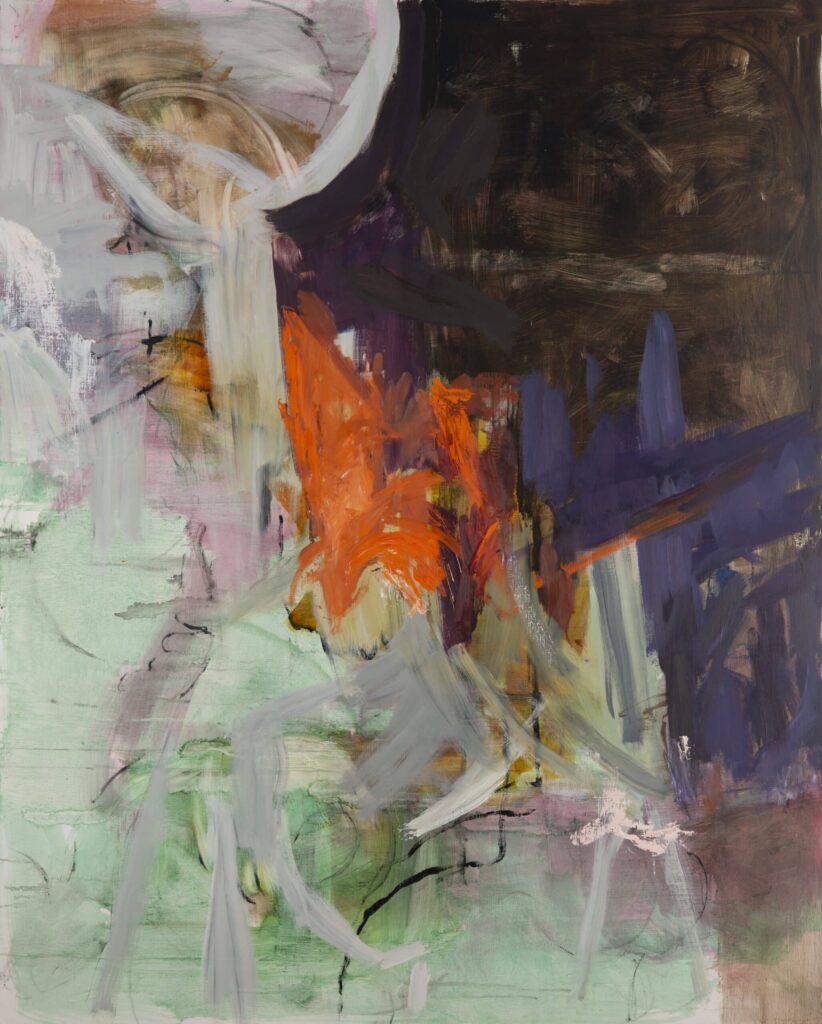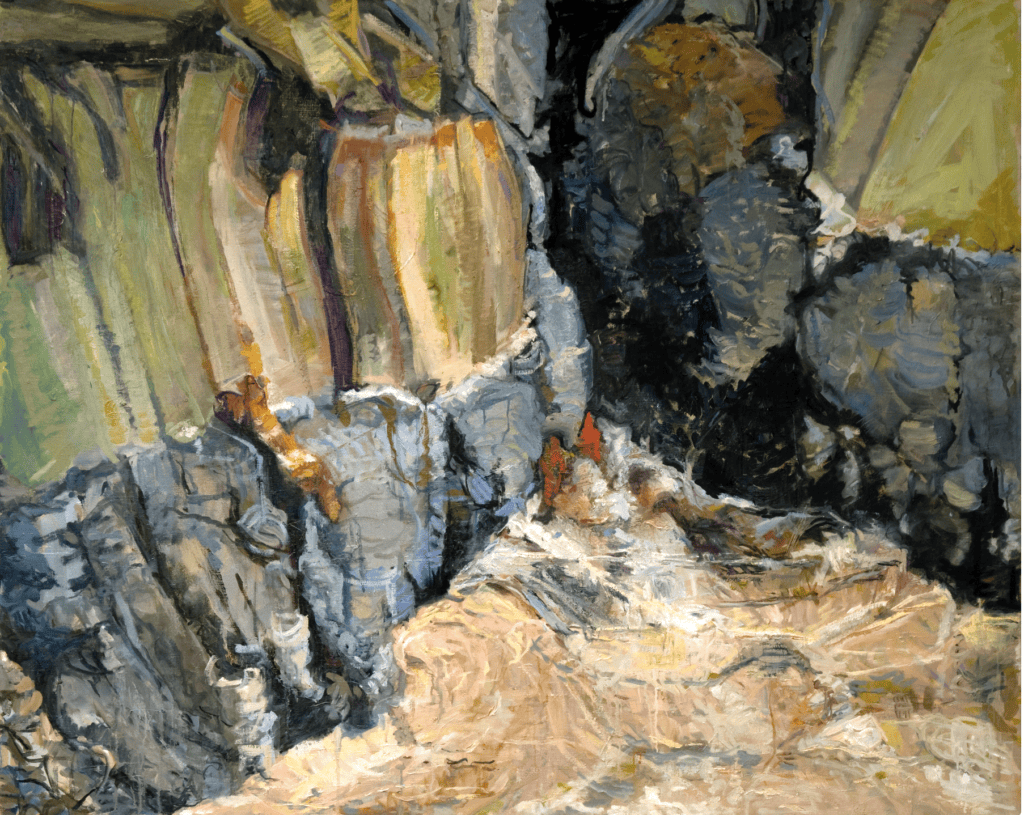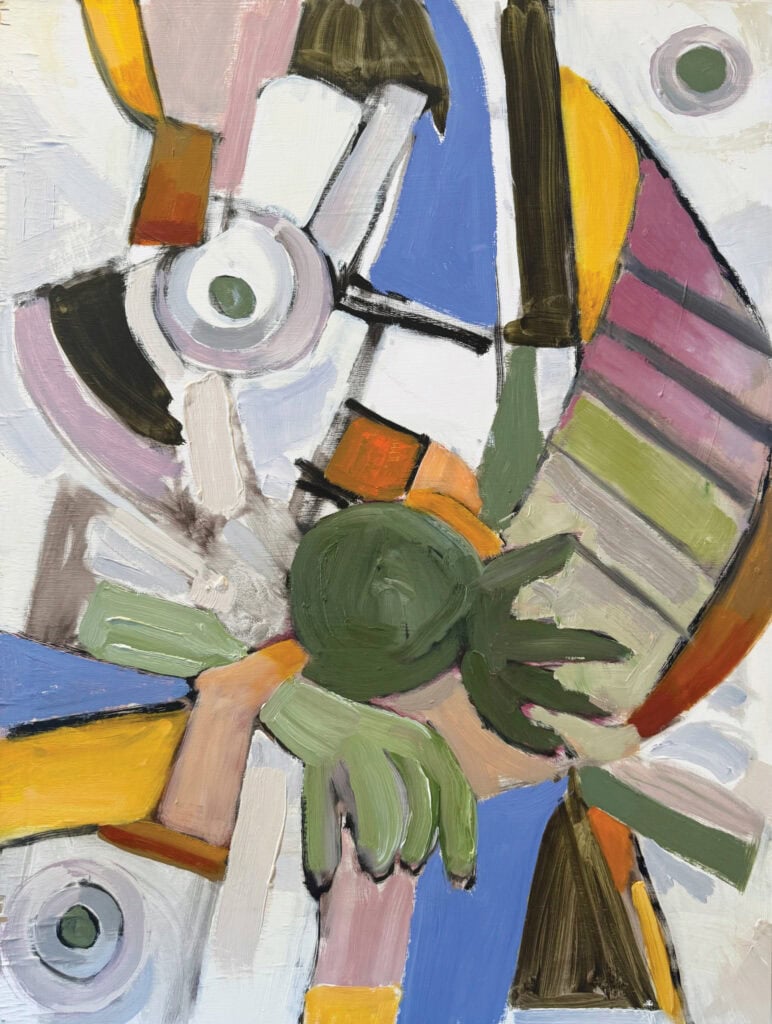
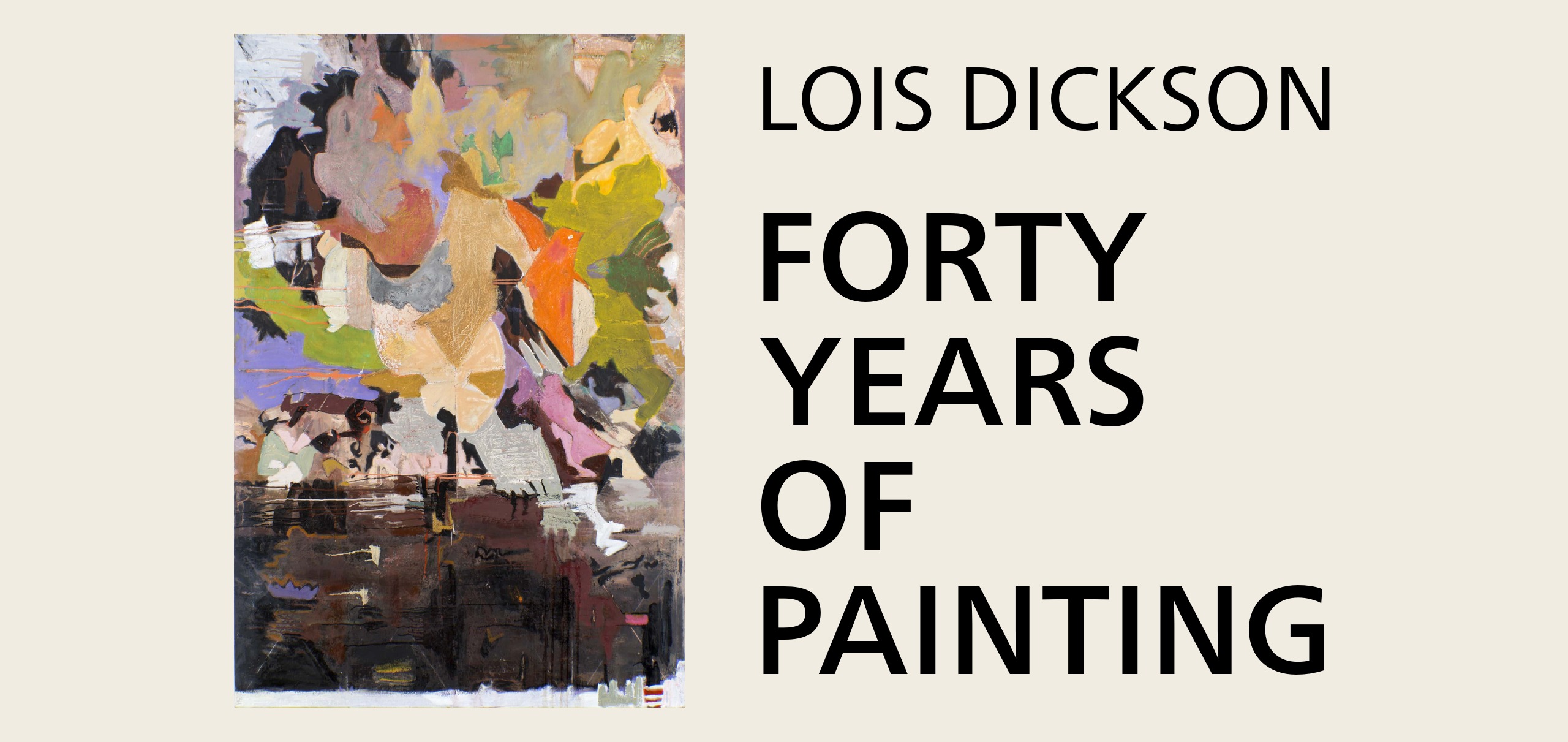
Forty Years of Painting presents an overview of Lois Dickson’s paintings across her prolific career, situating new works alongside a wide-spanning practice. Ranging from geometric abstraction to organic form, this diverse body of work traces the breadth of Dickson’s technical explorations, the natural development of key motifs, and her playful approach to painting.
“No piece is ever truly finished,” says the artist who works intuitively from life, memory, photo, and her imagination. Her paintings are “constructed, deconstructed, and reconstructed over days, weeks, often years.” Paintings made decades apart often bleed into one another. Echoes of the overtly organic shapes of fungi, rocks, and foliage, found in many of Dickson’s paintings, appear throughout even her most abstract work, including a new series inspired by photographs taken with a magnifying camera Lens.
The artist works from life and a collection of source materials–drawings, photographs, and studies–welcoming experimentation and spontaneity, often landing somewhere between transcription and abstraction. Spontaneous gestures follow a grid-like structure which underlines many of her paintings. Originally used as a compositional guide, the diamond grid gradually became an integral part of Dickson’s visual language. Sometimes it remains visible beneath the paint; elsewhere it quietly structures the composition before dissolving into gesture and color. At times, the paintings depart from this visual language entirely, and are composed spontaneously around texture, color, and form.
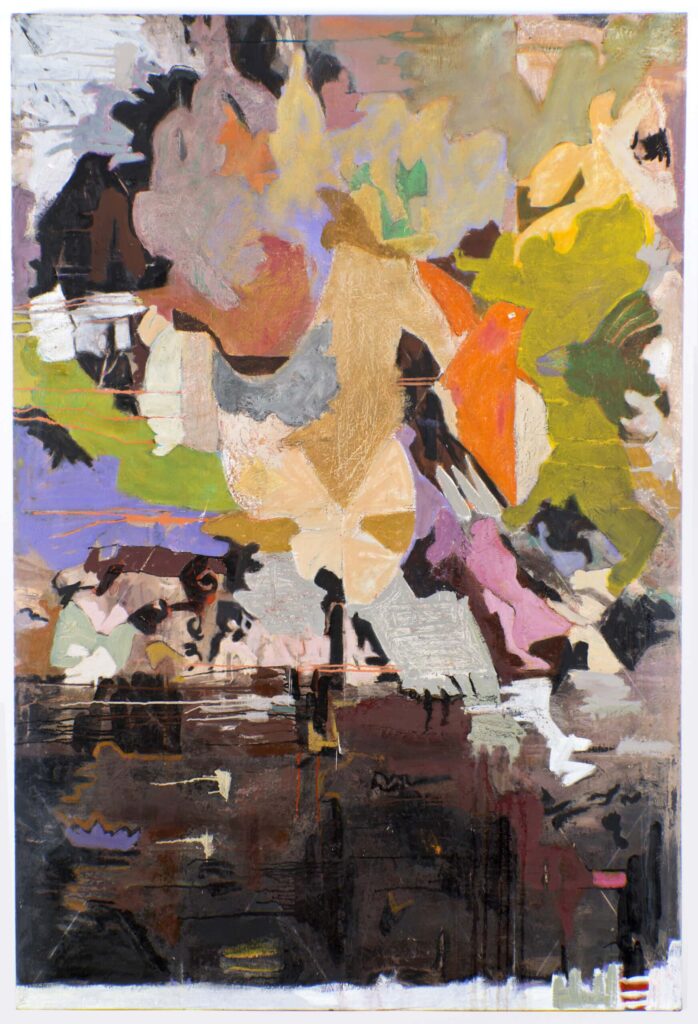
“It’s all open to interpretation and speculation,” explains Dickson. She hopes her paintings will invite multiple readings and interpretations, via unique avenues of personal connection. She is especially “happy when humor finds its way into the mix.”


PAINTINGS / IMAGES
NYSS (1990s)
At age sixty, after earning her MFA at the New York Academy of Art, Lois Dickson enrolled in the New York Studio School’s full-time Certificate Program, studying under Graham Nickson in the 1990s. The Studio School’s emphasis on observation, sustained looking, and rigorous studio practice became the foundation of her approach to painting, shaping the work she would make over the following decades.
Plein Air (2000–2010s)
In the late 1990s, she began splitting her time between New York City and the Hudson Valley, seizing every opportunity to paint outdoors. “Painting outdoors is one of the most exciting places to paint. It is difficult. It’s hard to get it all together because of continual changes, but when it works, and the day has constant light, and the wind doesn’t blow too hard… being able to execute a plein air painting is pure joy.” Plein air painting reinforced Dickson’s interest in nature and perceptual painting.
Fungi (2002–2004)
Fungi are among the most recurring visual motifs throughout Dickson’s forty years of oil paintings, stemming from her lifelong fascination with horticulture and forest ecologies. These forms appear in early representational works, often painted plein air or from watercolor studies, and persist as visual memories throughout later landscapes and abstractions alike.“ I used to collect mushrooms in the woods when I was a child and make gardens out of them. I would find Indian Pipes and line them up in large hollowed-out pieces of bark. I always identified with the shape.”
Travel (2002–2014)
In 2002, Dickson traveled to the Namib desert, where she studied and photographed the native Welwitschia Mirabilis—a Jurassic-era plant found only along the southwestern coast of Africa. Upon returning home, she painted prolifically, and became increasingly comfortable using photography as a point of departure. Collecting photographs, sketches, and memories of textures, forms, and colors became common practice. From her travels through South America, Yellowstone, the far East, the marshes of South Carolina, and her own backyard, objects from the natural world accumulated into an expanding archive of visual inspiration. She still has a closet full of stones, bones, and shells. Collage, fragmented imagery, and inventive uses of photographic reference became central in Dickson’s practice. From this uniquely observational yet intuitive process emerged an interplay of organic form and geometry that would later become a defining feature of her work, most notably through the diamond grid that acts as a loose architecture throughout her compositions. “As time goes by things beyond the obvious interest me—the source material evolves, the way I feel about the memory evolves, what I notice evolves.”
Improvisations (2009–2014)
While deeply inspired by painting outdoors and her travel diaries, Dickson remained committed to the act of painting itself. In 2009, she began working on a series of paintings entirely from imagination.To offset regiment, she turned to heavy texture, coating the canvas in thick primer, allowing the randomly generated textures to guide her painting in the absence of an image. These “improvisations” became an essential part of her practice, offering a space for experimentation and surprise.
Source (2013–2014)
During a trip to the Grand Canyon, she was struck by a singular mountain formation that later became the basis for Source, a major transitional work. Unable to “physically carry the landscape” with her, she translated its forms spontaneously through memory and abstraction. Source marked a synthesis between observed landscape, photo collage, and the imaginative image-making of her Improvisations. Rather than reproducing the desert landscape faithfully, Source, and the large body of paintings that grew from it, focused on transforming the recurring, ambiguous natural forms of the landscape into their own visual language.
Abstraction (2015–2017)
During the mid-2010s, inspired by Source and the Improvisations, Dickson had fully embraced abstraction. She continued to explore the diamond grid, scaling it up to a large “X”, which served as a prominent compositional guide in this series. Working first on small panels, she developed a process grounded in this structure, while remaining open to uncertainty and surprise. “I like a surprise, even to surprise myself. They really did just come—I just painted.”
Grid (2018–2019)
Following travels to Vietnam and Cambodia, a body of paintings emerged which reflect the region’s waterways, caves, and dense vegetation. Although these paintings utilize the diamond grid, they often depart from earlier works through more liberated gestural marks. Drawing on the same responsive process that informed her abstract work, Dickson painted what she encountered as evocative abstractions, privileging sensation and recollection over direct representation. The caves and rock formations of Vietnam deepened Dickson’s interest in hidden imagery, which she continued to explore when painting local sites such as Dover Stone Church, hiding ambiguous faces, creatures, and geological forms throughout. “The creatures are there if you look, if you want them to be.”
2020s-present
Drawing from Yellowstone, Glacier National Park, Vietnam, and the Hudson Valley, Dickson’s recent paintings collapse the distinctions between monumental and microscopic. She reflects on and finds humor in her enduring fascination with perception, possibility, and ambiguity; the work invites viewers to search for imagery secreted within their compositions. The artist continues to discover new ideas and processes. Most recently, she began taking photos of everyday objects using a micro-lens, adding these visual references to her ever-growing collection of source material.


Biography
Lois Dickson was born in 1930 in Cleveland, Ohio, and raised in a suburb nearby, where she spent long hours in nature, swimming and skating on Lake Erie. She studied at the University of Michigan, where she graduated in 1952 with a Bachelor of Arts in graphic design after which she always pursued art and design in one form or another, although did not pursue painting until 1990.
In 1952, Dickson moved to New Jersey, where she fostered a close relationship with her surroundings. Living on Emma Thatcher, a renowned horticulturists’ and patron of the arts’ estate, her appreciation for the arts as well as the natural world grew during this period. Landscapes, nature, and the forms and structures she found in them, would go on to inform many of Dickson’s later paintings.
Following this period, while raising her children, Chad, Pamela, and Lynne, Dickson ran a robust business crafting bespoke wastepaper baskets. Also working as a department store window designer, she continued to take drawing and painting classes in the evenings at Fairleigh Dickinson University. In the late 1970s, she began painting more often, while building a successful interior design practice. Shortly there-after, Dickson’s successes as a businesswoman and creative earned her a role as a corporate art consultant, leading her to set her own painting practice aside. By the 1980s, she was nationally recognized for her work as the lead curator for the collections of major corporations including Prudential, Exxon, and Time Life, where she worked with Irving Sandler, Jack Bauer, and Katharine Graham. In 1991, she was the lead project manager for the American Merchant Mariners’ Memorial, a major public sculpture by Marisol Escobar in the East River in New York, which is on permanent view.
At the age of sixty, following her decades-long corporate career, Dickson pursued a formal art education, earning a Master of Fine Arts at the New York Academy of Art and Honors in Drawing from the New York Studio School’s (NYSS) full time Certificate Program. Her paintings have since been shown extensively in solo and group exhibitions. She settled permanently in the Hudson Valley in the mid 1990s. At the age of 96, she continues to paint daily in her studio in North Chatham, NY.