
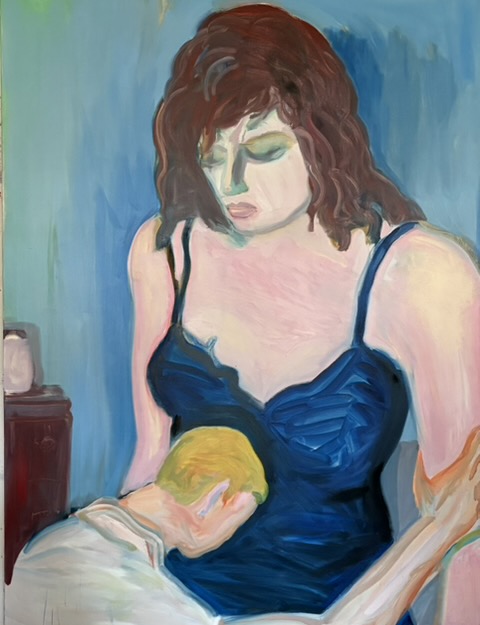
Acrylic on canvas
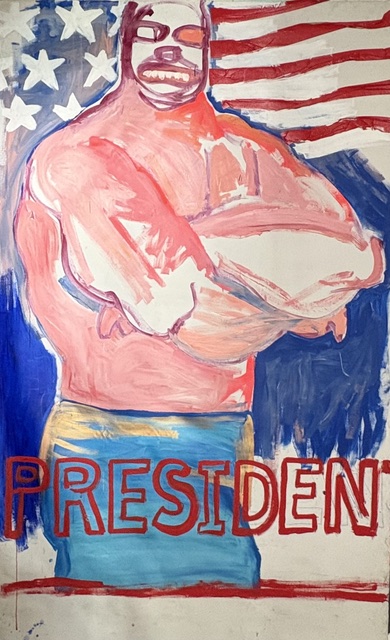
Acrylic on canvas
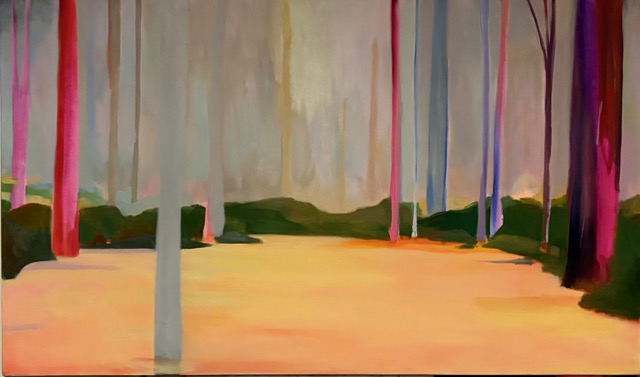
Acrylic on canvas
Stories in Stages: Paintings 1983–2023
For more than four decades, Stephen Lack has remained a punky painting savant, a firehose of unforgettable images. Lack has never been an artist to rest on his manifold accomplishments. Even today, working in his rural studio, with a museum’s worth of major paintings to share, he will invariably pull out something new that excites him, accompanied by a story about the real-world situation, often drawn from the daily news, that inspired it and how he hopes viewers might respond.
Still painting daily in his eighties, Lack was formed by two extraordinarily generative cultural scenes: Montreal in the late 1970s and New York’s East Village art world, which flowered in the early to mid-1980s. Both were characterized by a fertile hybridity, with artists, filmmakers, writers, and musicians propelling one another toward ever greater heights of audacity. Artists embraced an almost manic, space-filling productivity. Lack acquired the largest swaths of inexpensive canvas he could find, stapled them directly to the wall, and worked rapidly in quick-drying acrylics, rolling up each finished painting to make room for the next.
His early celebrity as an actor in gritty independent films such as Montreal Main and The Rubber Gun, followed by his appearances in David Cronenberg’s early horror classics, continually fed back into his studio practice. The relationship between cinematic storytelling and painting became central to his artistic vision.
Taking advantage of Time Space Limited’s storied tradition of providing ambitious exhibition opportunities to late-career artists living in Upstate New York, as well as its unusually expansive walls, Stories in Stages brings together seven large-scale paintings in concert with a dozen smaller works dating from 1983 to 2023. The exhibition seeks to illuminate Lack’s singular vision of how we live in a mediated world that relentlessly bombards us with shocking, seductive, and frequently absurd images. Over the four decades represented here, the sources of those images have shifted dramatically, from supermarket tabloids and sensationalist television to today’s endless streams of digital media engineered to hijack our attention.
Lack has always relished his own avoidance of polite subtlety. The paintings showcased here range from the truly shocking, in the spirit of the Weekly World News tabloid—riots, tawdry celebrities, grotesque spectacles, and absurdly cinematic explosions—to the psychological warfare of interpersonal relationships. His figures are often caught in moments of emotional extremity, their private dramas inflated to the scale of public spectacle.
Interspersed among the seven monstrously figurative paintings are works that initially appear to be luscious, almost pastoral landscapes. Yet, in the context of Lack’s dark storytelling instincts, even these seemingly tranquil scenes begin to resemble establishing shots in films whose quietude all but announces the violent disturbances about to enter the frame.
For viewers old enough to remember the pre-internet world of 1985, it may be instructive to consider how images that once seemed amusingly outrageous can now appear as quaint as a grandmother’s doily collection. The shocking has become ordinary, and the ordinary increasingly struggles to compete for our attention. Because Lack has never stopped painting, his work allows us to trace the gradual coarsening of our collective visual imagination, as well as the changing technologies through which we encounter the world.
In 2027, we may need Stephen Lack’s paintings more than ever. His exuberant, unruly, and frequently disturbing images offer us a way to negotiate the ceaseless barrage of stories and spectacles that constitute contemporary life. Through the stubbornly physical act of painting, Lack slows down the relentless flow of mediated imagery, transforming the disposable shocks of the moment into pictures that demand to be looked at, remembered, and reckoned with.